Iron in Turf Management: Moss, Disease and Nutrition – Why the Difference Matters
As shorter days and wetter conditions increase the pressure on golf course turf, iron often becomes part of the conversation. But not all iron applications serve the same purpose. Understanding the difference between moss treatment, disease management and plant nutrition can help greenkeepers make better decisions for healthier, more resilient turf.
Iron has long been used in turf management, particularly during autumn and winter. Greenkeepers are familiar with iron sulphate for moss treatments, improving turf colour and its traditional role in programmes aimed at reducing disease pressure.
However, iron is also an essential plant micronutrient, supporting chlorophyll production, photosynthesis and healthy turf development.
The distinction matters because using iron to influence surface conditions and using it to nourish the grass plant are different objectives – and they don't necessarily require the same formulation or application approach.
Why does moss become more prevalent in autumn and winter?
Moss can establish throughout the year, but autumn and winter frequently provide favourable conditions for its development.
Shorter daylight hours, lower light intensity and prolonged surface moisture can reduce the competitive advantage of desirable turfgrasses.
Several factors can contribute to moss establishment:
- Poor drainage and persistent moisture: Wet surfaces and poorly drained rootzones can favour moss development.
- Shade and reduced light: Less sunlight restricts healthy grass growth, particularly during the shorter days of autumn and winter.
- Compaction: Restricted air and water movement can weaken rooting and turf development.
- Low turf density: Thin, stressed or weakened turf leaves opportunities for moss to establish.
- Nutrient imbalances and unsuitable soil conditions: These can restrict healthy grass growth and reduce its ability to compete.
- Excessively close mowing: Can weaken the grass plant and create conditions in which moss becomes more competitive.
Importantly, moss isn't always an indication of acidic soil. Different moss species can thrive under different conditions, so identifying the underlying causes is essential.
Why is moss a problem on golf greens?
Moss occupies space within the playing surface, reducing the uniformity and consistency that greenkeepers work hard to achieve.
Depending on its extent and location, moss can contribute to:
- Uneven or inconsistent putting surfaces.
- Reduced turf density.
- Changes in surface texture and appearance.
- Reduced playing-surface quality.
- Greater maintenance requirements to restore desirable grass cover.
For greenkeepers, the challenge isn't simply removing visible moss. It's preventing the conditions that allow it to return.
Moss is often a symptom of an underlying turf management problem, rather than the problem itself.
Iron sulphate and traditional moss treatments
Iron sulphate (ferrous sulphate) has a long history in turf management.
It is used in some authorised moss-control formulations, where treatment causes moss to blacken and die back.
Iron sulphate is also used separately in turf nutrition and colour-management programmes, including some autumn and winter fertilisers.
However, these different applications should not be confused.
Both moss treatments and nutritional iron products may be applied as liquid sprays. The important differences lie in their intended purpose, formulation, application rate and how the iron interacts with the moss or grass plant.
An authorised iron-based moss treatment is intended to address an existing moss problem, primarily through contact with the moss. An iron nutrition programme focuses on supplying the nutrient in a form that the grass plant can absorb and utilise efficiently.
What about disease pressure?
Iron sulphate has also been used in autumn and winter turf programmes to help manage diseases such as Microdochium patch, historically known as Fusarium patch.
Its ability to influence surface pH is one factor associated with this practice, although research indicates that the relationship between iron applications, surface acidity and disease suppression is complex.
Studies have demonstrated reductions in Microdochium patch severity following certain iron sulphate applications. However, the degree of suppression varies, and repeated applications at higher rates have sometimes resulted in reduced turf quality.
Maintaining appropriate nutrition, managing surface moisture, improving airflow and supporting healthy turf remain important parts of reducing disease pressure.
Iron sulphate's traditional role in disease management should not be confused with supplying iron specifically for plant nutrition.
Does applying more iron mean better results?
Not necessarily.
Excessive iron applications can cause turf blackening, scorching or other plant injury, depending on the formulation, application rate and prevailing conditions.
Repeated applications also need to be considered in the context of the wider rootzone environment.
Soil pH, nutrient balance, moisture and microbial activity are interconnected. Changes to one part of this system can influence others, making it important to consider the cumulative effects of nutrient inputs.
This doesn't mean conventional iron sulphate is inherently harmful to soil biology. It means applications should be appropriate to the objective, and repeated treatments should not substitute for investigating the underlying causes of poor turf performance.
If moss keeps returning, the answer may lie beneath the surface rather than in another treatment.
Iron as an essential plant nutrient
Beyond its familiar association with moss treatment, disease management and turf colour, iron has an important nutritional role.
Iron supports several essential physiological processes, including:
- Chlorophyll formation: Iron is required for processes involved in producing the chlorophyll that gives turf its green colour.
- Photosynthesis: Supports the systems through which plants capture and use light energy.
- Enzyme activity: Participates in important metabolic reactions.
- Healthy plant function: Contributes to the processes necessary for normal growth and development.
Although turf requires iron in relatively small quantities compared with major nutrients such as nitrogen, phosphorus and potassium, its availability remains important.
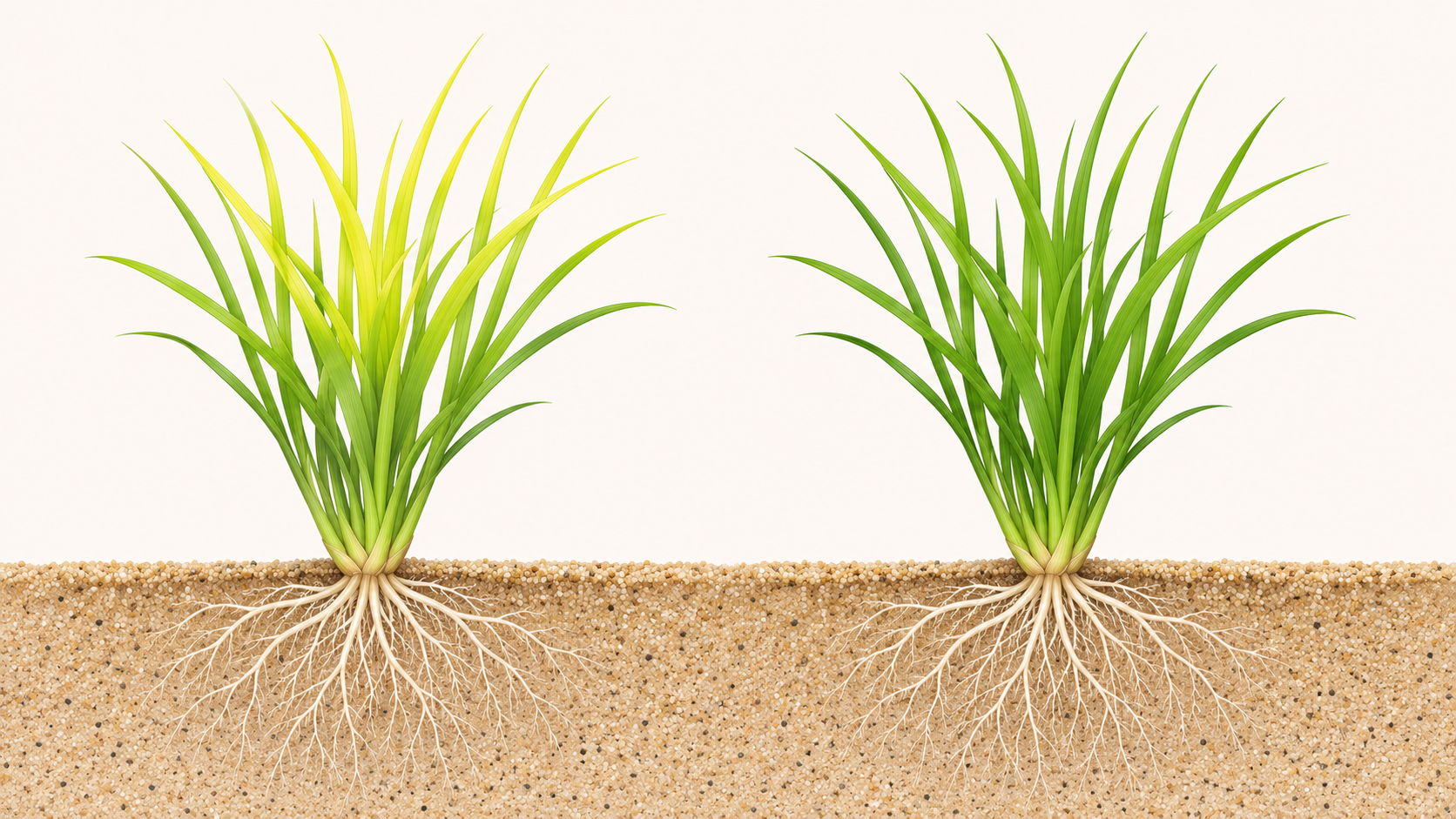
The challenge: Iron isn't always available to the plant
Iron can be present in the rootzone but remain unavailable for uptake.
This is particularly relevant where soil pH and interactions with other elements cause iron to form insoluble compounds.
Iron may react with phosphates, carbonates and other soil constituents, limiting the proportion available to the grass plant.
Consequently, applying additional iron to the soil doesn't automatically guarantee improved nutrition.
However, iron nutrition isn't limited to uptake through the roots. Iron can also be absorbed through turf foliage, providing another route for supplying this essential micronutrient.
The important question is not simply how much iron is applied, but how much remains available for the plant to absorb and use.
How does chelation improve iron availability?
Chelation is a process in which a nutrient, such as iron, is bound within a molecular structure that helps protect it from chemical reactions that could otherwise reduce its availability.
This can offer benefits through two routes of nutrient uptake:
- Foliar uptake: Chelated iron applied to turf foliage can be absorbed through the leaf surface, supplying iron directly to plant tissues. This can be particularly useful where root uptake is restricted by soil conditions.
- Root uptake: Where chelated iron reaches the rootzone, its protective structure helps maintain iron in a soluble form, reducing the likelihood of it becoming bound to soil constituents and unavailable for absorption by roots.
The effectiveness of either route depends on the formulation, application method, environmental conditions and needs of the plant.
A more efficient approach: S-Chelate Long Iron C-13
Soil Biology's S-Chelate Long Iron C-13 is designed to address the challenge of efficient iron nutrition.
Containing 13% elemental iron in a chelated ferrous form, it uses S-Chelation technology to help maintain nutrient solubility and availability across a broad range of soil conditions.
As a water-soluble formulation, S-Chelate Long Iron C-13 can be applied to turf foliage, providing a route for iron absorption through the leaves. Its chelation technology also helps maintain iron availability where the nutrient reaches the rootzone.
For turf managers, this offers several practical benefits:
- Efficient iron nutrition: Supplies iron in a chelated form designed to maintain plant availability and support uptake.
- Foliar and root availability: Supports iron nutrition through the leaf surface while helping maintain solubility where iron enters the rootzone.
- Performance across varying soil conditions: S-Chelation helps maintain iron availability across a broad range of pH and soil conditions.
- Low application rates: The formulation is designed for efficient nutrient delivery at comparatively low application rates.
- Healthy turf colour and plant function: Available iron supports chlorophyll production, photosynthesis and normal plant metabolism.
- Practical application: A highly soluble formulation suitable for incorporation into an appropriate turf nutrition programme.
As with any nutrient treatment, application should follow the product's technical guidance and take account of turf requirements, environmental conditions and the wider nutrition programme.
Treating the symptom or addressing the cause?
This is perhaps the most important distinction.
If the problem is moss, the first consideration should be why conditions are favouring its establishment.
That may involve reviewing drainage, compaction, shade, mowing practices, nutrition or other factors affecting turf density.
If the objective is to supply iron as a nutrient, the focus should be on selecting a formulation that delivers that nutrient efficiently.
Neither approach replaces the other.
S-Chelate Long Iron C-13 is a nutritional product, not a moss-control or disease-treatment product. Its purpose is to improve the availability of iron to the grass plant, supporting healthy growth and turf performance.
Better turf starts with better rootzone understanding
At Soil Biology, we believe effective turf management begins with understanding what's happening beneath the surface.
Rather than simply applying more inputs, our approach focuses on identifying the factors limiting turf performance and selecting practical solutions that address them.
That might mean improving drainage, encouraging healthier root development, correcting nutrient imbalances or choosing more efficient nutrient formulations.
The result is a more considered approach to managing turf health, resilience and long-term performance.
Because healthier turf isn't necessarily about applying more. It's about making better use of what you apply.
Find out more
Discover how S-Chelate Long Iron C-13 supports efficient iron nutrition, or explore our Soil & Rootzone Review service to better understand the conditions affecting your turf.